
I joined the OCEANLINKS project on a postdoctoral contract in January 2026 to work specifically on the task ‘Study area of marine stations and regionalisation of knowledge’.
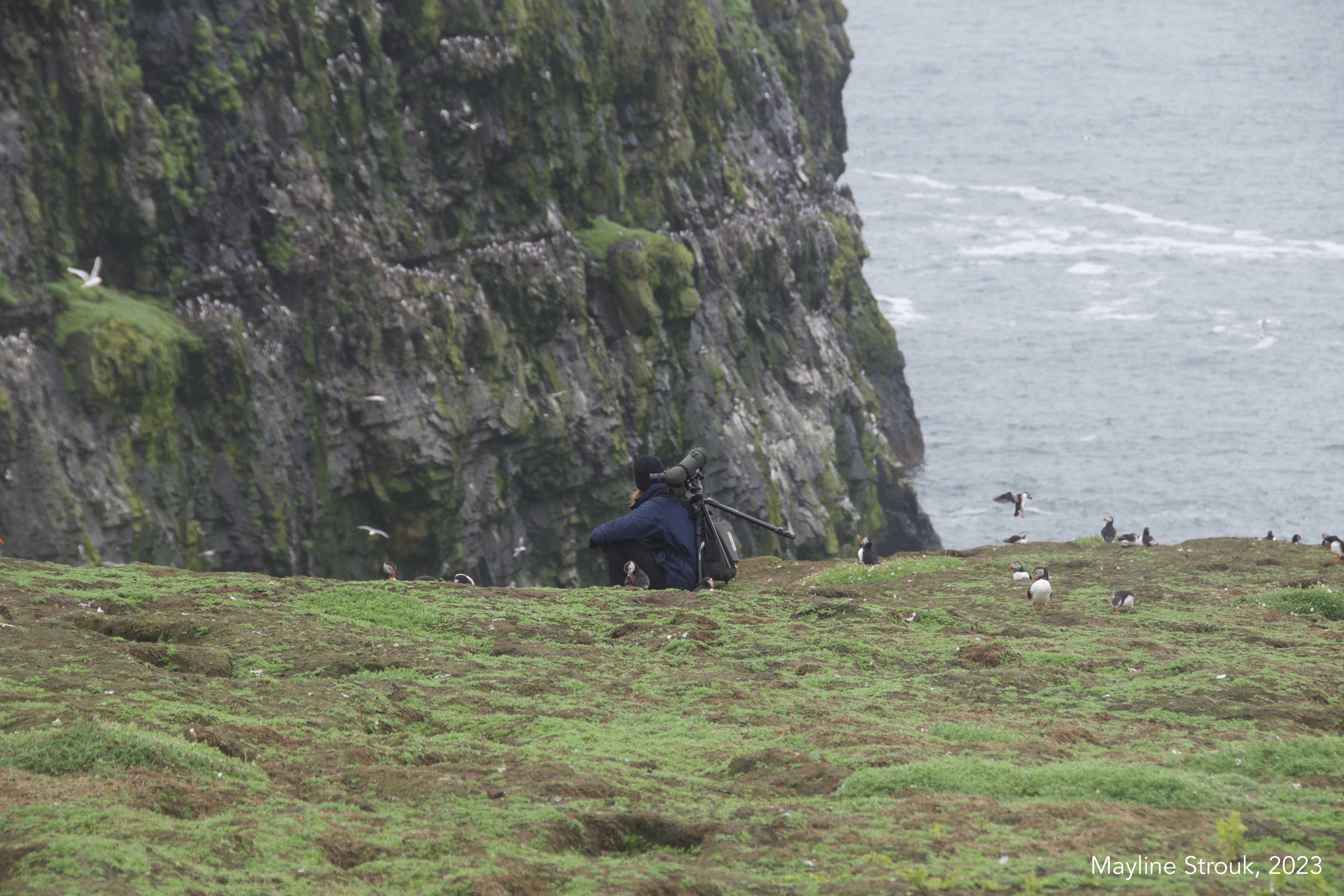
Before that, in 2025, I completed my PhD at the University of Edinburgh, which focused on the (im)mobilities of marine ornithologists in the Arctic. In other words, I was interested in how researchers choose the sites where they collect scientific data, focusing on the case of seabird research. Seabirds are mobile, alternating between colonies – often far removed from any human presence – during their breeding season and the open sea during their migration. Thus, for researchers, it is a matter of negotiating their access to the birds by selecting colonies where they can not only visit, but above all stay and return, sometimes for several decades. The concept of (im)mobility has emerged as a way of examining the intertwining trajectories of researchers and seabirds, who negotiate and renew the colonies as ‘scientific field sites’ through their comings and goings.
This thesis also aims to foster dialogue between human geography and the sociology of science and technology (STS), conducted primarily at the STIS (Science, Technology and Innovation Studies) unit of the University of Edinburgh, under the joint supervision of Niki Vermeulen, who is also a member of the OCEANLINKS project. Through this work, I have examined the geography of science and ecological knowledge to investigate not only how places emerge as sites of scientific inquiry, but above all how they are maintained, passed on, or disappear. I conducted a series of interviews with marine ornithologists and undertook several ethnographic field studies: on Skomer (Wales), in Boulogne-sur-Mer (France) and on several occasions in Iceland (particularly on the Vestmannaeyjar archipelago). Among the findings of my thesis, I demonstrated how the choice of field sites shapes ornithologists’ scientific trajectories; I examined the challenges of long-term monitoring and how these have evolved in the context of the projectification of academic research; and I explored the role of new technologies, such as tracking devices, in reshaping fieldwork practices.
In my new role as a postdoc, I continue to work on the topic of research trajectories and fieldwork selection in the geography of marine sciences. I am exploring the role of marine research stations in these trajectories, from the perspective of regionalisation: for example, does working at a station on the Mediterranean coast necessarily mean studying the Mediterranean environment? I am particularly interested in specialisation in polar regions and how this ties in with the study of ecological issues in the stations’ local environments. To this end, I am conducting interviews with researchers; I have carried out a small ethnographic study at the Banyuls station; and I plan to undertake in-depth observations with students from the “Marine Sciences” master’s programme at Sorbonne University.